
DAY BY DAY ACTIVITIES


MÓDULO 1
READING: A Busy Day at “The Corner Store”
Context: It is 11:00 AM on a Saturday. The store is full of customers.
Every day, Mark works as a sales assistant at “The Corner Store.” He usually opens the shop at 9:00 AM and organizes the products on the shelves. He loves his job because he talks to many people.
However, today is different because there is a big sale. Right now, the store is very crowded. Mark is helping a customer who needs a new jacket. At the same time, his co-worker, Elena, is checking the inventory on her tablet because some items are out of stock.
At the cashier, two people are waiting in line. They are buying clothes for a party. Usually, customers pay with cash, but today everyone is using credit cards. Mark’s manager is calling the warehouse because they need more shoes. It is a very busy morning!

Retail English Quiz: “The Corner Store”
GRAMMAR FOCUS
1. Simple Present (Presente Simple)
Se usa para hablar de rutinas, hábitos y hechos generales.
Explicación
- Afirmativo: Usamos el verbo en su forma base.
- Ojo: Con He, She, It, agregamos una -s al final del verbo.
- Negativo: Usamos el auxiliar don’t (o doesn’t para He/She/It) + el verbo normal.
- Interrogativo: Usamos el auxiliar Do (o Does) al inicio.
Examples
- Routine: I work every day. (Yo trabajo cada día).
- Third person: She lives in Santiago. (Ella vive en Santiago).
- Negative: They don’t speak English. (Ellos no hablan inglés).
- Question: Do you study at night? (¿Estudias por la noche?).
Exercises: Simple Present
A. Complete the sentences with the correct form of the verb:
- I ________ (clean) my house on Saturdays.
- My brother ________ (work) in a factory.
- We ________ (not / like) cold weather.
- ________ you ________ (drink) coffee in the morning?
2. Simple Past (Pasado Simple)
Se usa para acciones que comenzaron y terminaron en el pasado.
Explicación
- Verbos Regulares: Solo agregamos -ed al final (ejemplo: walk / walked).
- Verbos Irregulares: Cambian su forma y debemos memorizarlos (ejemplo: go / went).
- Negativo: Usamos didn’t + el verbo en su forma normal (sin -ed).
- Interrogativo: Usamos el auxiliar Did al inicio.
Examples
- Regular: I visited my family last month. (Visité a mi familia el mes pasado).
- Irregular: He went to the supermarket yesterday. (Él fue al supermercado ayer).
- Negative: I didn’t watch TV last night. (No vi tele anoche).
- Question: Did you finish the homework? (¿Terminaste la tarea?).
Exercises: Simple Past
B. Change these sentences into the past:
- I play soccer. Yesterday, I ________ soccer.
- She eats an apple. She ________ an apple this morning. (Eat is irregular: ate)
- They don’t arrive late. They ________ late.
- Do you see the movie? ________ you ________ the movie?
Reading – The English Language learning
Reading Passage: English Proficiency & Global Data
Learning a second language is a tool for professional growth. However, statistics show a significant gap between Chile and developed nations. In the EF EPI 2025, Chile scored 517 points, ranking 54th globally. This is considered a “Moderate Proficiency” level, while top European countries score over 600 points.
Economic Impact: Proficiency in English can increase salary expectations in the global market by approximately 30% to 50%.
To bridge this gap, successful countries prioritize Communication over Perfection and Digital Exposure (using videos, games, and apps in English). For an adult student in Chile, the main goal is to move from a “Basic” level to “Functional” skills.
Vocabulary Spotlight: Key Data Terms
| English Term | Traducción | Contexto / Context |
|---|---|---|
| Proficiency | Dominio / Competencia | Nivel de habilidad (Moderate Proficiency). |
| Ranking / Rank | Clasificación / Puesto | Posición en la lista mundial (54°). |
| Gap | Brecha / Diferencia | Distancia entre Chile y la OCDE. |
| Average | Promedio | Punto medio internacional (476 pts). |
| Fully fluent | Completamente fluido | Hablar a la perfección (solo el 2%). |
| Score / Points | Puntaje / Puntos | Valor numérico en pruebas (PISA/EF). |
| Attainment | Logro / Nivel alcanzado | Cantidad de titulados en educación superior. |
| Drop | Caída / Descenso | Baja de rendimiento (535 vs 439). |
| To bridge | Acortar / Superar | Acción de reducir la brecha educativa. |
| Salary expectations | Expectativas salariales | Aumento de sueldo (30%-50%) por inglés. |
Final Assessment: Global English Data
The positions of questions and answers change on every restart.
Video Módulo 1
QUIZZES Youtube Módulo 1
Exercises Módulo 1
I. MULTIPLE CHOICE: SIMPLE PRESENT
Encierra en un círculo la opción correcta (Rutinas y hábitos).
- I __________ my emails every morning. (a. check / b. checks / c. checking)
- The bus __________ at 7:30 AM. (a. stop / b. stops / c. stopping)
- We __________ have lunch at the office. (a. doesn’t / b. don’t / c. not)
- __________ your husband work on weekends? (a. Do / b. Is / c. Does)
- They __________ English on Tuesday nights. (a. study / b. studies / c. studying)
- My sister __________ in a hospital. (a. work / b. works / c. working)
- You __________ need a permit to enter. (a. don’t / b. doesn’t / c. no)
- __________ you want some coffee? (a. Does / b. Do / c. Are)
- The supermarket __________ at 9:00 PM. (a. close / b. closes / c. closing)
- I __________ drink soda; I prefer water. (a. doesn’t / b. don’t / c. am not)
II. FILL IN THE BLANKS: SIMPLE PAST
Completa con el verbo en PASADO. Presta atención si es Regular (ed) o Irregular.
- Yesterday, I __________ (visit) my grandmother.
- We __________ (eat) pizza for dinner last night. (Irregular: eat ate)
- The mechanic __________ (fix) my car on Monday.
- I __________ (see) a great movie last weekend. (Irregular: see saw)
- She __________ (arrive) late to the meeting.
- They __________ (go) to the beach last summer. (Irregular: go went)
- We __________ (pay) the electricity bill yesterday. (Irregular: pay paid)
- The children __________ (play) in the park all afternoon.
- I __________ (wake up) very early this morning. (Irregular: wake up woke up)
- He __________ (call) his boss two hours ago.
III. NEGATIVES AND QUESTIONS: MIXED TENSES
Transforma las oraciones según el tiempo y la instrucción (Negativa o Pregunta).
- Present: He lives in Puente Alto. (Negativa): He _________________________ in Puente Alto.
- Past: You saw the news. (Pregunta): ________ you ________ the news?
- Present: They speak Spanish. (Negativa): They _________________________ Spanish.
- Past: She cooked lentils. (Negativa): She _________________________ lentils.
- Present: You need help. (Pregunta): ________ you ________ help?
- Past: I went to the doctor. (Negativa): I _________________________ to the doctor.
- Present: It rains a lot here. (Negativa): It _________________________ a lot here.
- Past: They bought the bread. (Pregunta): ________ they ________ the bread?
- Present: She studies at CEIA. (Pregunta): ________ she ________ at CEIA?
- Past: We finished the project. (Negativa): We _________________________ the project.
IV. WRITING PRODUCTION
Escribe sobre tu propia experiencia (Usa oraciones completas):
- Write 5 things you do every day (Simple Present):
(Ej: I drink tea, I go to work…) - Write 5 things you did last week (Simple Past):
(Ej: I cleaned my house, I went to the feria…)
MÓDULO 2
Rewrite each sentence by adding the correct Question Tag at the end. Remember the “Mirror Rule” (Positive Negative / Negative
Positive).
Present Simple (Habits & Facts)
- You speak English fluently.
________________________________? - Your brother doesn’t like broccoli.
________________________________? - The train leaves at 8:00 AM.
________________________________? - They don’t live in Edinburgh anymore.
________________________________? - She works at the local hospital.
________________________________?
Past Simple (Finished Actions)
- You visited the castle last summer.
________________________________? - He didn’t call you yesterday.
________________________________? - We bought a new car last week.
________________________________? - The team didn’t win the match.
________________________________? - It snowed a lot last winter.
________________________________?
Verbe “To Be” (Is, Are, Was, Were)
- You are ready for the test.
________________________________? - She wasn’t at school on Monday.
________________________________? - The children were very tired.
________________________________? - This movie isn’t very interesting.
________________________________? - (Challenge!) I am late for the meeting.
________________________________?
Video Módulo 2
QUIZZES Youtube Módulo 2
Reading Comprehension
COMPREHENSIONLuis, the mechanic
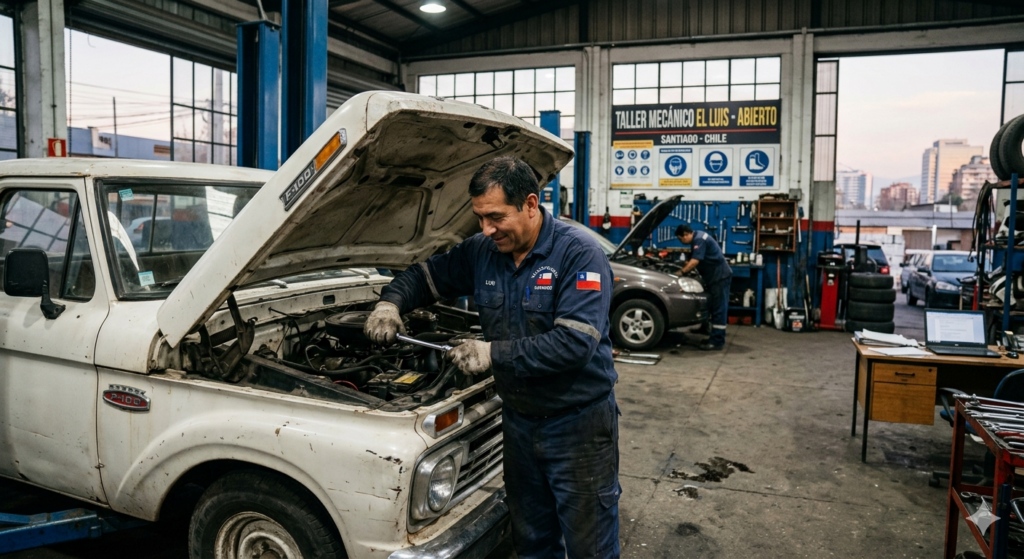
My name is Luis and I work in a garage in Santiago. Every morning, I arrive early because I must check all the tools before starting. Right now, I am repairing an old truck, but it is a difficult job. Yesterday, I fixed two cars and I was very tired at the end of the day. My boss is happy because I can solve many mechanical problems quickly. However, we are not working tomorrow because it is a holiday. I should rest and spend time with my family at home.
I. Reading Comprehension: Questions
Answer the following questions in English.
- Where does Luis work?
- Why does he arrive early every morning?
- What is Luis repairing right now?
- How many cars did he fix yesterday?
- Why is his boss happy?
II. Vocabulary: Matching
Match the English word with its Spanish meaning.
| English | Spanish |
| 7. Tools | ___ a) Jefe |
| 8. Truck | ___ b) Arreglar / Reparar |
| 9. Fix | ___ c) Herramientas |
| 10. Boss | ___ d) Feriado |
| 11. Holiday | ___ e) Camión |
III. True or False? (10 Points)
Write T (True) or F (False). Correct the false ones.
12 Luis works in a hospital in Santiago.
13.- He is repairing a small motorcycle right now.
14.- Luis was very tired yesterday.
15.- He is working tomorrow.
16.- Luis should rest and spend time with his family.
READING COMPREHENSION
MÓDULO 3
ANOMALOUS VERBS / MODAL VERBS
- Contenidos: Uso de verbos modales (can, could, may, might, should, ought to, must) y vocabulario técnico de seguridad laboral.
- Objetivo: Comunicar instrucciones, advertencias y consejos en contextos de trabajo para mejorar la seguridad y la eficiencia operativa.
- Propósito en la vida real: Capacitar al estudiante para comprender normativas internacionales, prevenir accidentes y desenvolverse con autonomía en entornos laborales bilingües.
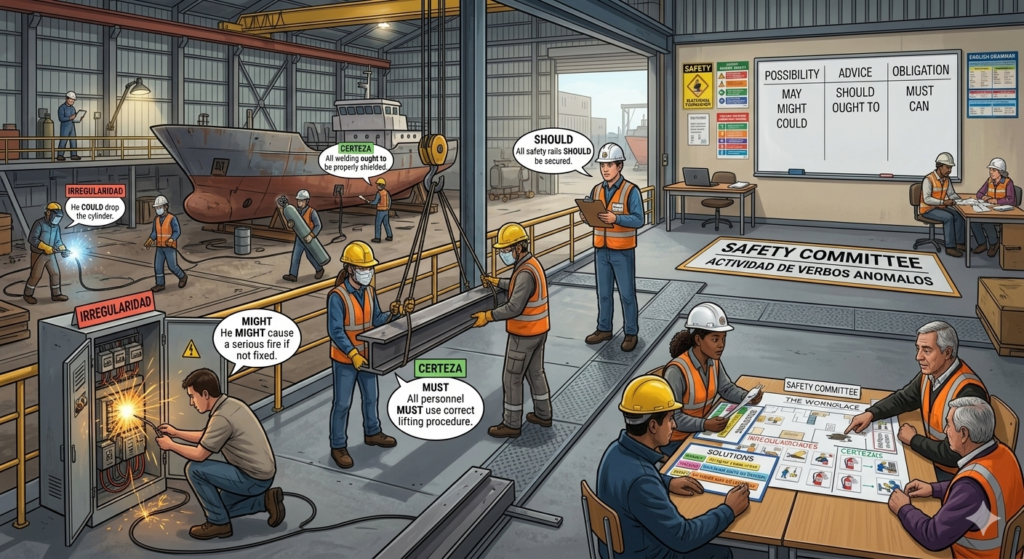
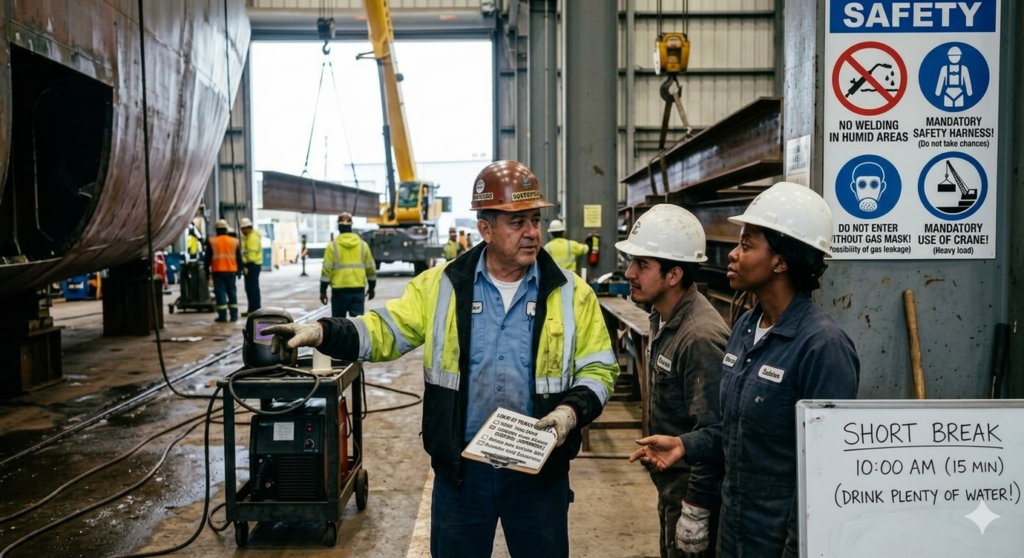
Encuentren en la imagen los momentos exactos de la conversación:
- Roberto y la soldadura: “You mustn’t weld there yet. It’s too wet” (Se ve el área húmeda cerca del casco del barco).
- Sandra y las vigas: “You ought to use the crane for that” (Se observa la grúa moviendo las vigas de acero).
- El equipo de seguridad: “You must wear your harness at all times” (Todos los trabajadores portan su equipo reglamentario).
- Aviso de descanso: En la pizarra se lee el recordatorio: “You can take 15 minutes, but you should drink plenty of water”.
DIALOGUE: Safety First at the Construction Site
Characters:
- Supervisor: Mr. Morales
- Worker 1: Roberto
- Worker 2: Sandra
Supervisor: Good morning, team. Listen, we have a lot of work today, so you must follow all safety rules.
Roberto: Good morning, sir. Can we start with the welding in the hull?
Supervisor: No, Roberto. You mustn’t weld there yet. It’s too wet. You could cause a short circuit.
Sandra: That’s true. Mr. Morales, should we move the steel beams first?
Supervisor: Yes, Sandra. You ought to use the crane for that. It’s too heavy for a person. Remember, you must wear your harness at all times.
Roberto: Understood. What about the chemical area? It smells strange.
Supervisor: Good catch. There might be a gas leak. You may enter only with a mask. If you feel sick, you must stop immediately.
Sandra: Could we have a short break at 10:00 AM? It might be a very hot day.
Supervisor: Yes, you can take 15 minutes, but you should drink plenty of water. Safety is our priority!
Industrial Safety Final Exam
MÓDULO 4
GENERAL EXERCISES
I.- Match the Columns (Vocabulary Skills)
A
1.- Score
2.- Average
3.-Higher Education
4.- Proficiency
5.- Benchmark
B
___ a) A standard or level that is considered typical.
___ b) University or professional studies after high school.
___ c) The number of points someone gets in a test.
___ d) The ability to do something well (skill level).
___ e) A point of reference for comparison.
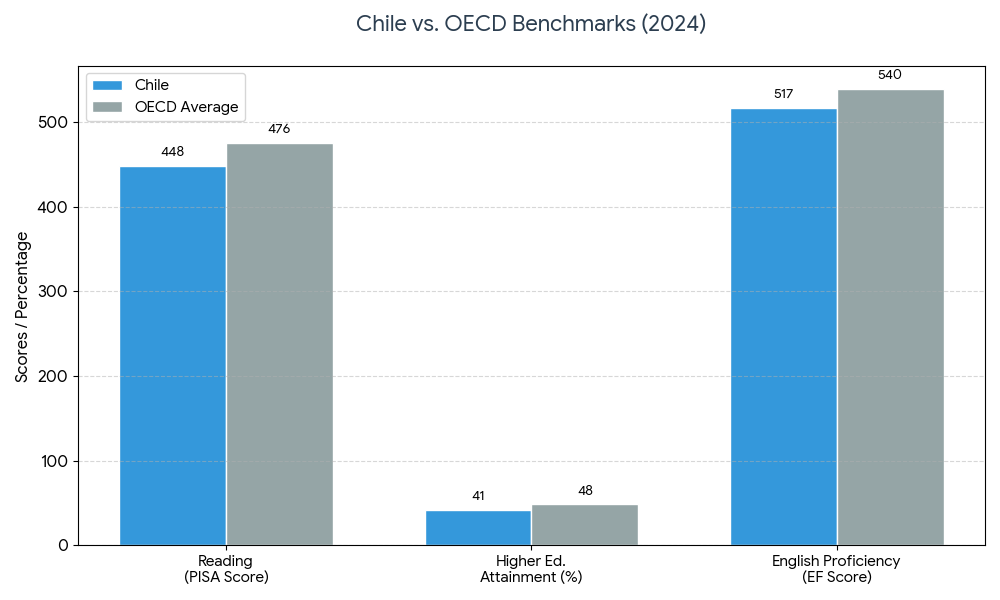
II.- Answer the following questions based on the chart.
- What is the title of the chart?
- Which country/group has the highest score in Reading?
- What is Chile’s percentage in Higher Education Attainment?
- What does the blue bar represent?
- What is the EF Score for Chile in English Proficiency?
III.- True or False
Write T (True) or F (False) for each statement.
- ____ Chile has a higher Reading score than the OECD average.
- ____ The OECD average for Higher Education is 48%.
- ____ The chart compares Chile with other OECD countries.
- ____ English Proficiency is measured using the EF Score.
- ____ In all three categories, Chile is above the OECD average
IV.- Sentence Completion
Complete the sentences using information from the image.
- The PISA score for Reading in Chile is ________ points.
- The OECD average for English Proficiency is ________.
- There is a ________ % gap in Higher Education Attainment between Chile and the OECD.
- The color ________ represents the OECD Average.
- This chart shows data from the year ________.
MODULO 5
Technology & Communication Quiz
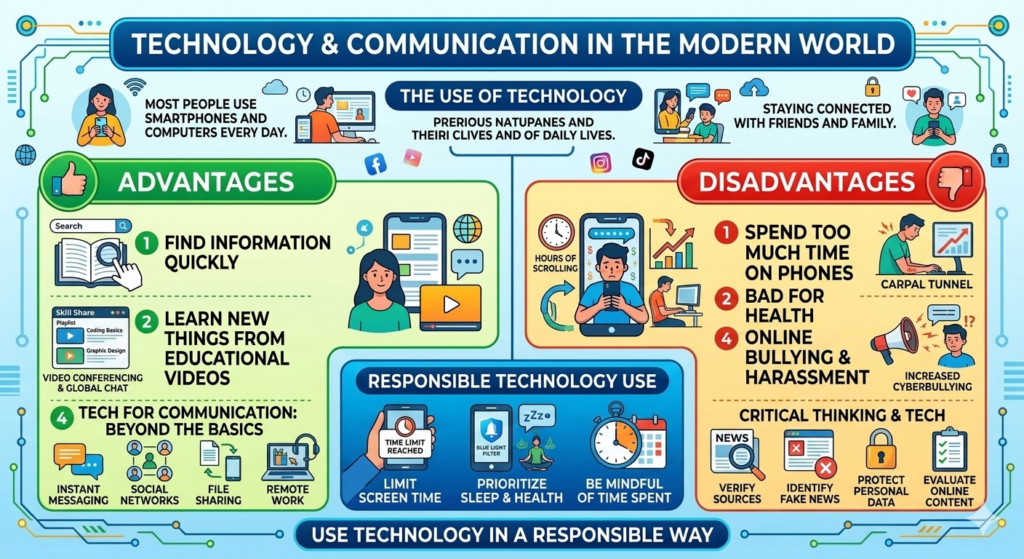
1. According to the infographic, what is a primary advantage of using technology?
A) Spending more time on social media.
B) Finding information quickly.
C) Increasing the hours of scrolling.
D) Protecting personal data from hackers.
2. Which activity is listed under “Learn new things from educational videos”?
A) Online bullying.
B) Remote work.
C) Coding Basics.
D) File sharing.
3. What is a specific physical health risk mentioned as a disadvantage?
A) Blue light filter issues.
B) Carpal Tunnel syndrome.
C) Lack of sleep.
D) Decreased concentration.
4. The section “Tech for Communication” includes which of the following?
A) Identifying fake news.
B) Limiting screen time.
C) Remote work and file sharing.
D) Evaluating online content.
5. What does the icon with the “Zzz” represent in the “Responsible Use” section?
A) Being mindful of time.
B) Prioritizing sleep and health.
C) Using instant messaging at night.
D) The danger of cyberbullying.
6. Under “Critical Thinking”, what is the first step recommended to handle news?
A) Share it with friends and family.
B) Verify sources.
C) Limit screen time.
D) Post it on social networks.
7. Which of these is considered a “Disadvantage” of technology?
A) Global chat.
B) Online bullying and harassment.
C) Staying connected with family.
D) Video conferencing.
8. What should a responsible user do regarding their “Screen Time”?
A) Increase it daily.
B) Ignore the time limit reached.
C) Limit it.
D) Use it mainly for scrolling.
9. “Protect personal data” and “Identify fake news” are parts of:
A) Advantages of Tech.
B) Responsible Technology Use.
C) Critical Thinking & Tech.
D) Communication Basics.
10. What is the main message at the bottom of the infographic?
A) Use technology as much as possible.
B) Use technology in a responsible way.
C) Avoid using smartphones every day.
D) Only use technology for educational videos.
- B | 2. C | 3. B | 4. C | 5. B | 6. B | 7. B | 8. C | 9. C | 10. B
QUIZZES
Accede a una gran variedad de evaluaciones clic