

ITEM I: (BIOGRAPHY) – MARÍA JOSÉ QUINTANILLA (Comprensión Lectora)
Instructions: Read the text and choose the correct answer (A, B, C, or D).

María José Quintanilla is a famous Chilean singer, actress, and television host. She was born in Santiago in 1990. She became popular at a very young age when she participated in the talent show Rojo, Fama Contrafama in 2002. Her powerful voice captivated the audience, and her first album, México Lindo y Querido, became a huge commercial success. Over the years, she has managed to sustain her career by evolving from a children’s ranchera singer into a charismatic TV presenter on morning shows. Today, she balances her passion for music with her work in media, being an inspiration for many people who start their projects from scratch.
1. Where was María José Quintanilla born?
2. In which year did she become famous on the talent show Rojo?
3. What was the title of her first successful album?
4. What is her current job role mentioned in the text?
5. [VOCABULARY] What is the correct Spanish translation for the word “sustain” highlighted in the text?
6. [INFERENCE] Based on the text, what can we infer about María José’s career?
ITEM II: (DESCRIPTION OF A PLACE) – BUIN ZOO (Comprensión Lectora)
Instructions: Read the text and choose the correct answer (A, B, C, or D).
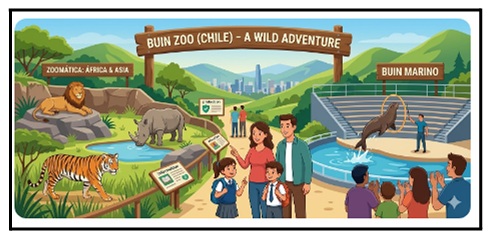
Buin Zoo is the largest and most modern zoo in Chile, located in the Metropolitan Region, just south of Santiago. It is a wild adventure designed to protect animals and educate visitors about biodiversity. The park is organized by geographic zones, representing different continents like Africa, Asia, and America. Families can see exotic animals such as lions, rhinos, and Bengal tigers. One of its main attractions is the “Buin Marino” amphitheater, where marine animals show their skills. The zoo focuses deeply on animal welfare and conservation, making it a favorite destination for educational school trips and weekend family tours.
7. What is Buin Zoo’s primary focus according to the text?
8. How is the park organized layout-wise?
9. Which animals can you see in the “Buin Marino” section?
10. [VOCABULARY] What is the correct Spanish translation for the word “educate” highlighted in the text?
11. [INFERENCE] Why is Buin Zoo a popular destination for school trips?
ITEM III: WORKPLACE SAFETY (Interpretación de Imagen y Señalética)
Instructions: Analyze the safety sign descriptions and choose the correct option.
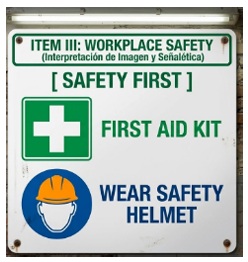
12. What is the main objective of this workplace sign?
13. If an employee gets injured or cut, what item should they look for?
14. What is the mandatory action when entering an area with the helmet icon?
15. The phrase “SAFETY FIRST” translates to Spanish as:
16. In which of the following areas is a “Safety Helmet” absolutely necessary?
ITEM IV: (STATISTICAL DATA) – CHILEAN EDUCATION PERCENTAGES
Instructions: Analyze the data chart comparing the distribution of adult students (EPJA), Regular Schooling (Formal), and Higher Education (Superior), then answer the questions.
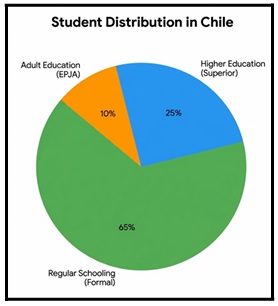
17. Which educational modality has the highest percentage of students?
18. What is the specific percentage for Adult Education (EPJA)?
19. What is the percentage of students in Higher Education (Superior)?
20. If you combine EPJA (10%) and Superior (25%), what is the total percentage?
21. Which sentence is correct according to the chart?
22. The word “Percentage” in Spanish means:
23. The word “Student” in Spanish means:
24. What type of document or graphic is this?
25. Complete the statement: “Regular Schooling represents __________ of the total.”