IA


Reading Comprehension
Artificial Intelligence is not brand new. The idea started in the 1950s when scientists asked: Can machines think? For many years, AI was very basic. However, in the 2020s, AI changed completely. Thanks to faster computers and massive amounts of internet data, systems like ChatGPT and image generators became available to everyone.
Today, AI is developing at lightning speed. It can write essays, create art, and analyze medical data in seconds.
AI in Chile and the World
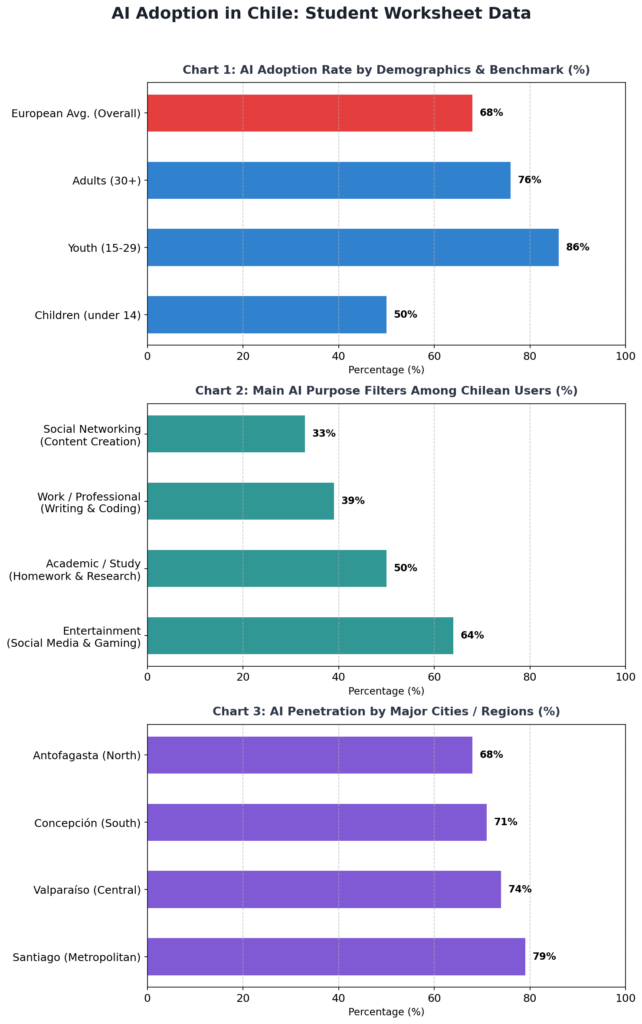
Globally, AI is transforming industries. Companies use it to automate tasks, while students use it to study. [1]
In Chile, AI adoption is growing very fast. Chile is actually a leader in Latin America! The country launched its first National AI Policy to help schools and businesses adopt this technology safely. Young Chileans use AI mostly for studying and social media, while companies use it to understand data and improve customer service.
Implications and Future Projections
AI brings great benefits, but also big challenges.
- The Positive: It saves time, helps doctors detect illnesses faster, and creates new jobs in technology.
- The Negative: It can create fake news, violate user privacy, and make some traditional jobs disappear.
In the future, AI will become even smarter. It will likely control autonomous cars, predict climate change events, and offer fully personalized education for every student.
Who Controls AI? (Regulation and Oversight)
Are there organizations that control or supervise AI? Yes and no. It depends on where you look.
- In the World: Right now, there is no single “Global AI Police.” However, regions like the European Union (EU) created the EU AI Act. This is a strict law that bans dangerous AI uses and forces companies to be honest about how their systems work.
- In Chile: Chile does not have a specific “AI Enforcement Organization” yet. Instead, the government uses existing laws about digital data privacy to protect citizens. However, Chilean lawmakers are currently discussing new bills to regulate AI risks specifically.
Why is it hard to regulate AI?
Technology moves too fast. Laws take months or years to write, but AI changes every single week! Governments want to protect people without stopping innovation.
Glossary:
1.- Adoption: Starting to use something new.
2.- Automate: Making a process happen automatically using machines.
3.- Policy: A set of official ideas or plans used as a basis for making decisions.
4.- Privacy: The right to keep personal information secret.
5.- Regulation: Official rules made by a government.
6.- Oversight: The action of supervising or watching over something
AI in Chile & The World: Interactive Quiz
Complete all sections and click the button at the bottom to check your grade.
Part 1: True or False (7 Points)
Select True or False based on the text reading and statistical charts.
-
Chile launched its first National AI Policy in the year 2021.
-
According to data, Chilean youth (ages 15-24) have the highest AI adoption rate in the country.
-
In Chile, Artificial Intelligence is used more frequently for entertainment than for academic tasks.
-
There is currently a single, centralized “Global AI Police” organization that regulates technology worldwide.
-
Chile’s working-age AI adoption rate is higher than the overall European Union average.
-
The city of Concepción has a higher AI usage percentage than the Metropolitan Region (Santiago).
-
AI tools are capable of generating human biases because they learn directly from historical human data.
Part 2: Vocabulary Matching (7 Points)
Select the letter of the correct definition for each technical term.
- 1. Adoption
- 2. Automate
- 3. Policy
- 4. Privacy
- 5. Regulation
- 6. Oversight
- 7. Bias
B. The process of starting to use a new system or tool.
C. Making a process run by machines instead of humans.
D. An unfair preference or prejudice learned from digital data.
E. The action of supervising or watching over an industry.
F. An official plan used as a framework for decisions.
G. The right of individuals to keep personal info secret.
Part 3: Fill in the Blanks (7 Points)
Type the exact correct word from the word bank. (Write in lowercase).
- Modern AI developed significantly because computers became much
- Chile is recognized as a digital technology
- Students and companies use AI to handle and analyze blocks of
- While AI automates tasks, it will also transform and create new
- In agriculture, farmers implement AI models to monitor crops and
- Older generations typically adopt modern software tools at a
- Regulating technology is hard because legislative
Part 4: Inferring Information (7 Points)
Select the option that represents a logical conclusion based on global and local tech facts.
-
Why is Santiago’s AI adoption rate (72%) higher than regional areas like Antofagasta (46%)?
-
What can be inferred about the European Union’s lower average AI adoption rate (33%) compared to Spain (64%)?
-
If a Chilean company uses an AI model for customer service, what ethical aspect must they prioritize?
-
Why did Chile launch a “National AI Policy” framework?
-
Given that AI can generate fake news, what skill becomes crucial for modern Chilean learners?
-
What does the high academic usage filter (74%) imply about how AI has affected students in Chile?
-
Why is the European Union’s “EU AI Act” an important international model?
Part 5: Sentence Translation (7 Points)
Select the most accurate English translation for each Spanish sentence.
-
“La inteligencia artificial está avanzando a pasos agigantados.”
-
“Chile es un líder en la adopción de tecnología en América Latina.”
-
“Los gobiernos quieren proteger a las personas sin frenar la innovación.”
-
“La IA ayuda a los agricultores a monitorear cultivos y ahorrar agua.”
-
“Los sistemas de IA pueden mostrar sesgos si aprenden de datos antiguos.”
-
“No existe una policía global de la inteligencia artificial todavía.”
-
“Los jóvenes usan la IA principalmente para estudiar y redes sociales.”