


INTERPRETING IMAGES
IMAGE 1
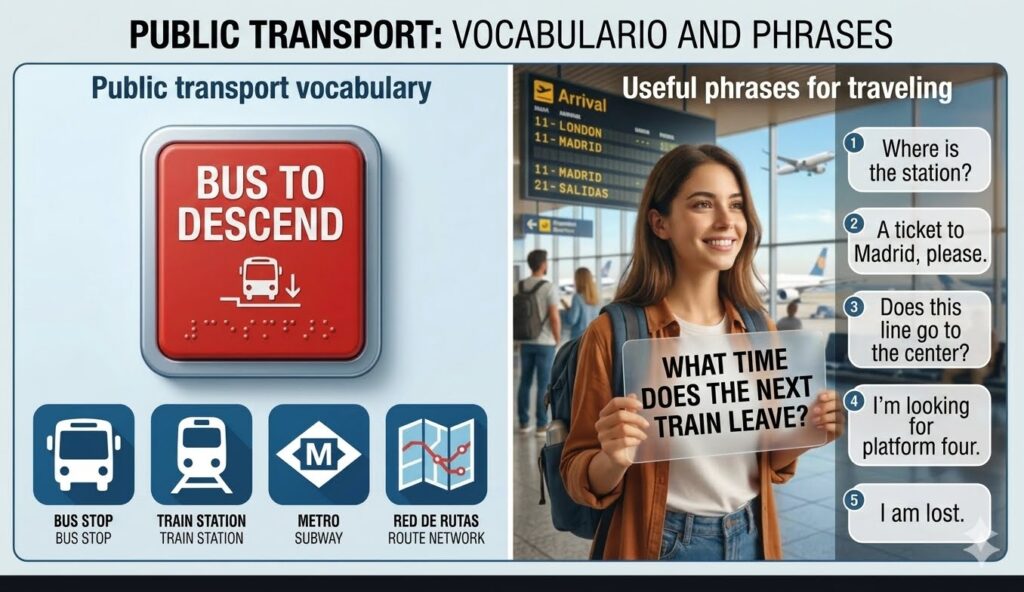
1. What does the young woman’s sign ask?
- A) Where is the bus stop?
- B) What time does the next train leave?
- C) Is this line going to the center?
- D) How much is a ticket to Madrid?
2. If you want to go to the capital of Spain, which phrase should you use?
- A) I’m looking for platform four.
- B) Where is the station?
- C) A ticket to Madrid, please.
- D) I am lost.
3. Which phrase matches option number 5?
- A) Does this line go to the center?
- B) Where is the station?
- C) Bus stop.
- D) I am lost.
4. What is the English translation for “estación de tren”?
- A) Bus stop
- B) Subway
- C) Train station
- D) Route network
5. If a passenger does not know where they are, what should they say?
- A) I am lost.
- B) What time does the next train leave?
- C) I’m looking for platform four.
- D) Where is the station?
IMAGE 2

1.- Contextual Matching (Emparejamiento por Contexto)
Une los términos en inglés con su traducción al español basándote en los íconos de la sección DUTIES:
- A) Organize products
- B) Control inventory
- C) Prepare delivery boxes
-
- Preparar cajas de entrega
-
- Organizar productos
-
- Controlar el inventario
2. Multiple Choice: Requirements (Selección Múltiple)
En la sección REQUIREMENTS, aparece la palabra “Punctuality” junto a un diploma y un teclado. ¿Qué significa este requisito?
- A) Saber trabajar en equipo.
- B) Puntualidad.
- C) Tener auto propio.
- D) Disponibilidad inmediata.
3. True or False: Experience (Verdadero o Falso)
La sección EXPERIENCE muestra un gráfico de barras con un signo de interrogación y la frase: “Experience not required”.
- Pregunta: ¿Significa esto que es obligatorio tener experiencia previa para postular? (True / False)
4. Fill in the Blanks: Benefits (Completar Espacios)
Observa los íconos de la sección BENEFITS (una cruz médica y un plato de comida caliente) y completa la traducción:
- Health insurance = Seguro de __________.
- Free lunch = __________ gratis.
5. Identification: Application (Identificación)
En la sección azul inferior (HOW TO APPLY), identifica las palabras en inglés que corresponden a estos elementos esenciales para postular a un empleo:
- A) ¿Cómo se dice “Currículum”?
- B) ¿Cómo se dice “Fecha límite”?
IMAGE 3
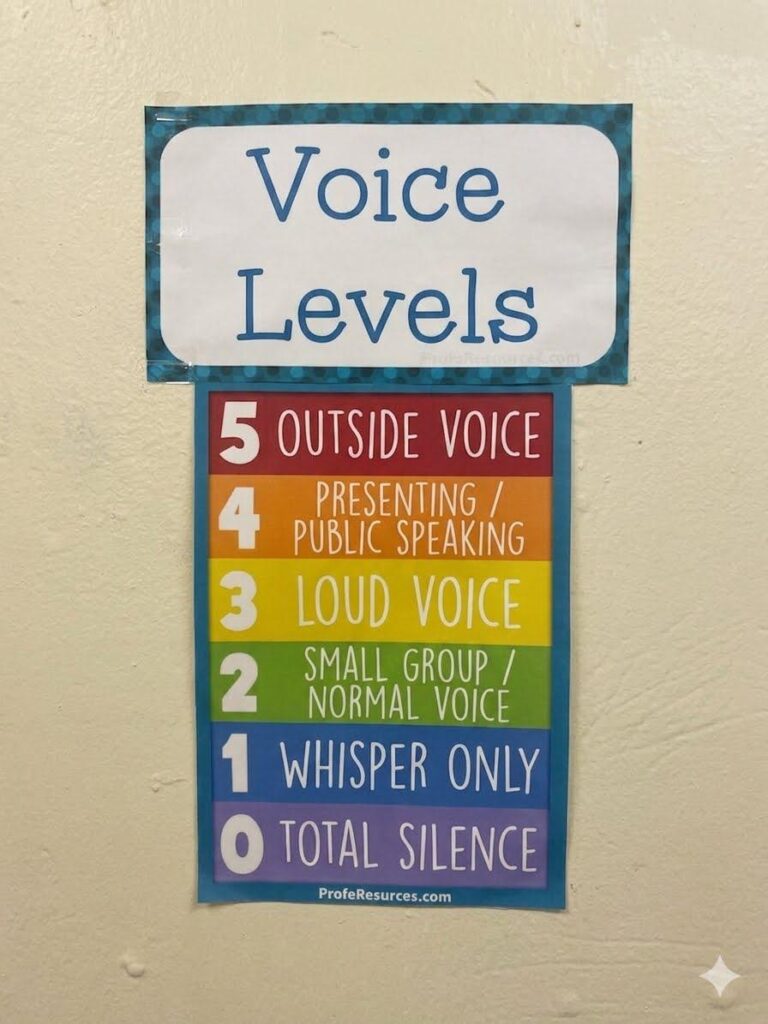
True or False (Verdadero o Falso) basados en el cartel de niveles de voz para practicar la comprensión de lectura:
1. Level 0 means you can speak quietly with your partner.
- True / False
2. Level 2 is the appropriate volume for normal conversations or small group work.
- True / False
3. “Whisper only” corresponds to Voice Level 1.
- True / False
4. You should use Level 5 when you are presenting or speaking in public.
- True / False
5. Level 3 (“Loud Voice”) is a higher volume than Level 4 (“Presenting”).
- True / False
Si lo deseas, te puedo:
IMAGE 4
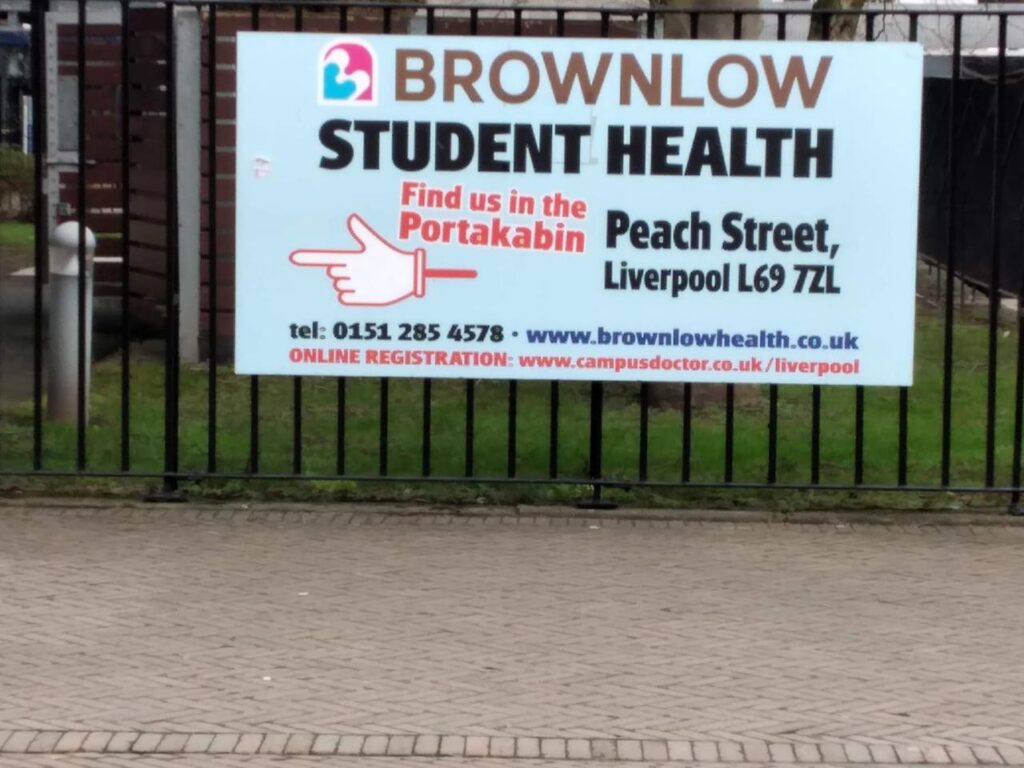
Match the English terms (1-5) with their correct Spanish translations (A-E):
| Column A (English) | Column B (Spanish) |
|---|---|
| 1. Student Health | A) Registro en línea |
| 2. Find us | B) Dirección / Calle |
| 3. Portakabin | C) Salud estudiantil |
| 4. Peach Street | D) Encuéntranos |
| 5. Online registration | E) Módulo prefabricado / Caseta |
IMAGE 5
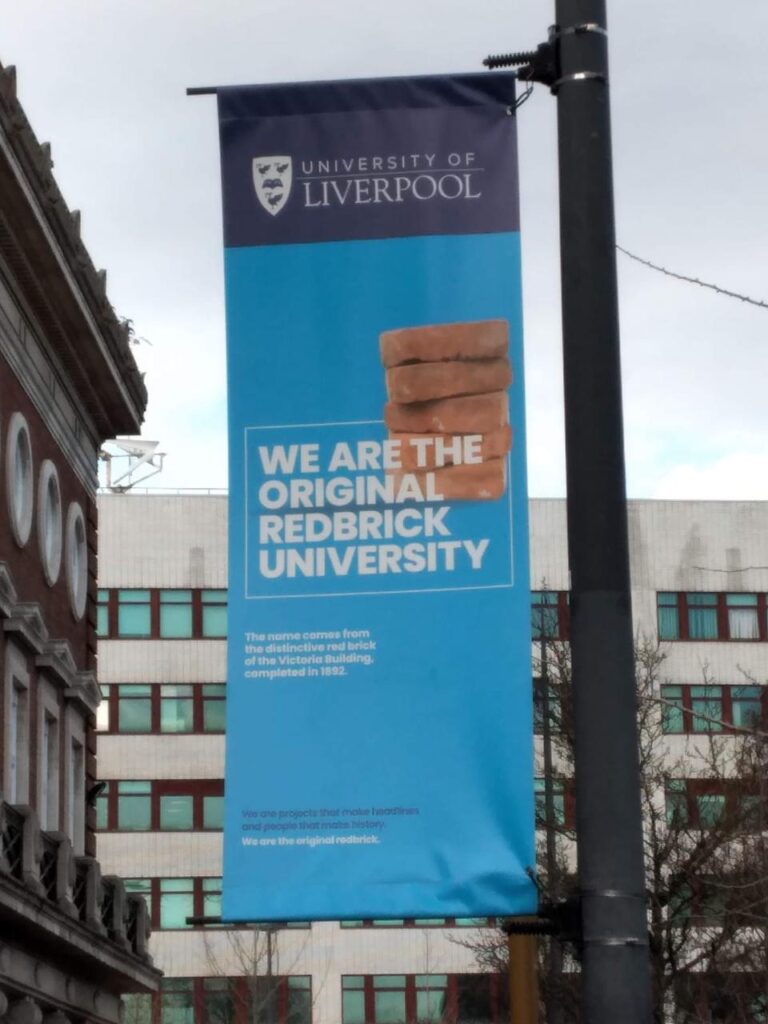
5 preguntas de selección múltiple en inglés, con 4 alternativas cada una, basado en la información del cartel de la Universidad de Liverpool:
1. Which university does this banner belong to?
- A) University of London
- B) University of Manchester
- C) University of Liverpool
- D) University of Oxford
2. What is the historic title claimed by this institution on the banner?
- A) The Original Redbrick University
- B) The Best Modern University
- C) The Oldest Stone University
- D) The First Green Campus
3. Where does the name “Redbrick” come from?
- A) From the red books used in the library.
- B) From the distinctive red brick of the Victoria Building.
- C) From the red fields surrounding the city.
- D) From the color of the university’s uniform.
4. In what year was the Victoria Building completed?
- A) 1882
- B) 1902
- C) 1892
- D) 1992
5. According to the small text at the bottom, what do their projects and people do?
- A) Make money and build houses.
- B) Make headlines and make history.
- C) Travel the world and study nature.
- D) Win sports trophies and games.
IMAGE 6
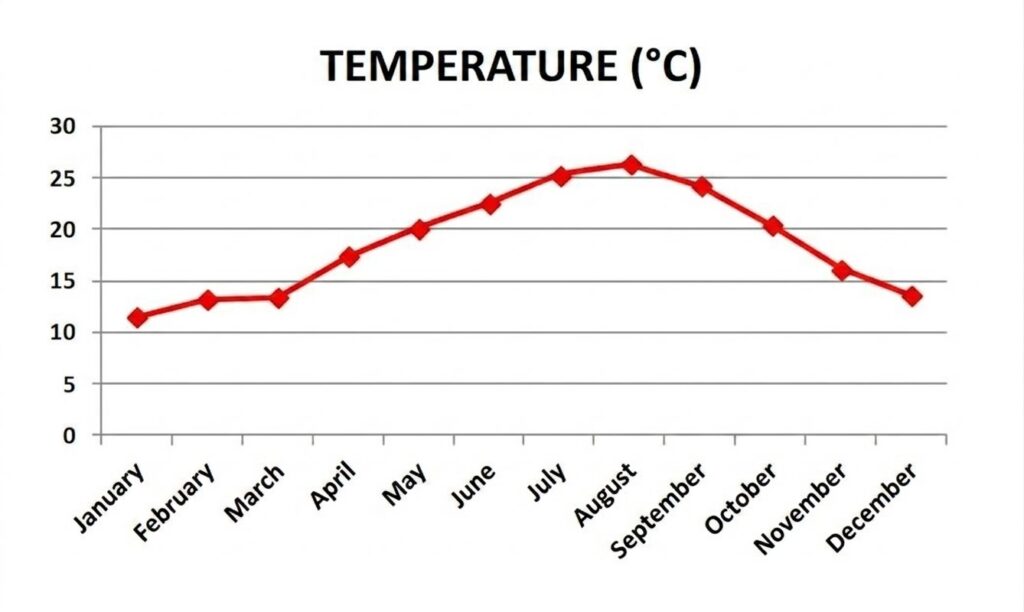
1. Which month of the year has the highest average temperature?
2. What is the approximate temperature recorded for the month of January?
3. Which two consecutive months show almost the exact same temperature at the beginning of the year?
4. Does the temperature generally increase or decrease between August and December?
5. In which month does the temperature first drop back down to around 20 °C after the summer peak?
IMAGE 7
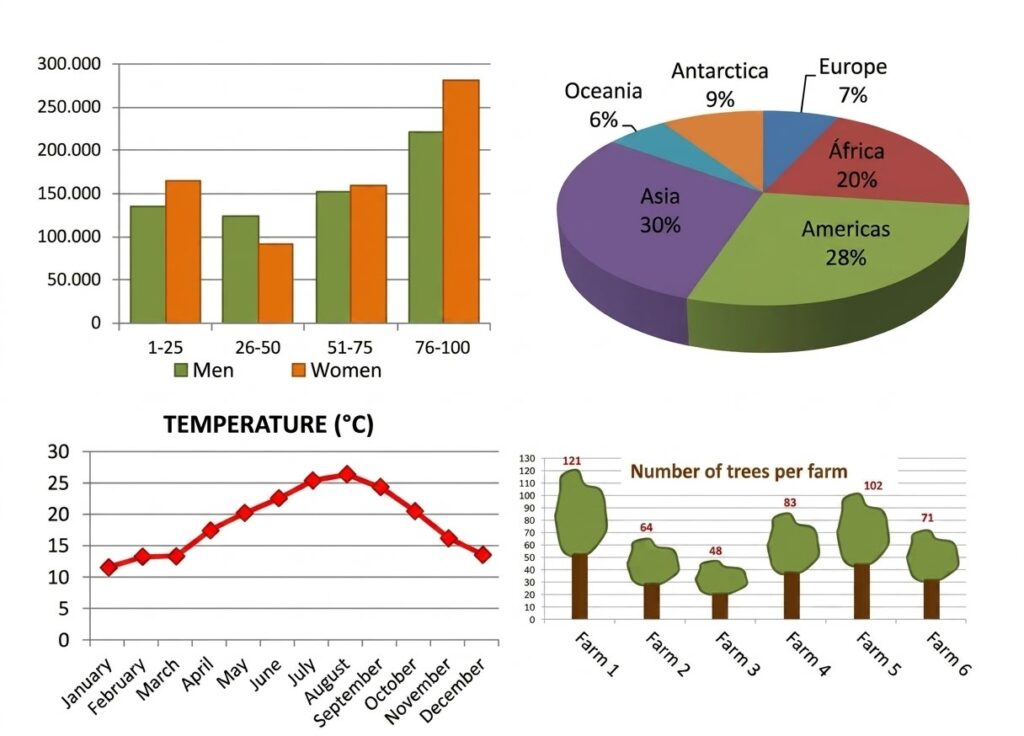
1. In the top-left bar chart, which age group has a significantly higher number of women than men?
- A) 1-25
- B) 26-50
- C) 51-75
- D) 76-100
2. According to the pie chart, which continent accounts for the largest percentage (30%)?
- A) Americas
- B) Africa
- C) Asia
- D) Europe
3. In the temperature graph, which month reaches the highest peak?
- A) July
- B) August
- C) September
- D) June
4. In the bottom-right chart, which farm has the lowest number of trees?
- A) Farm 1
- B) Farm 3
- C) Farm 4
- D) Farm 6
5. Based on the “Number of trees per farm” chart, how many trees does Farm 5 have?
- A) 121
- B) 64
- C) 83
- D) 102
…
- Top-left bar chart (Population by age and gender): It compares the number of men and women divided into four age ranges (1-25, 26-50, 51-75, and 76-100 years old). It shows that the 76 to 100 age group is the largest, with a notable majority of women.
- Top-right pie chart (Distribution by continents): It displays the percentage of a global variable distributed by continents. Asia leads with 30%, followed by the Americas (28%), Africa (20%), Antarctica (9%), Europe (7%), and Oceania (6%).
- Bottom-left line graph (Monthly temperature): It records the evolution of the average temperature in degrees Celsius (°C) throughout the 12 months of the year. A seasonal climate is observed, where the hottest month is August (approx. 26 °C) and the coldest is January (approx. 11 °C).
- Bottom-right bar and icon chart (Agricultural holdings): It shows the exact number of trees on each of the 6 numbered farms or agricultural holdings. Farm 1 has the highest number (121 trees) and Farm 3 has the lowest (48 trees).
IMAGE 8
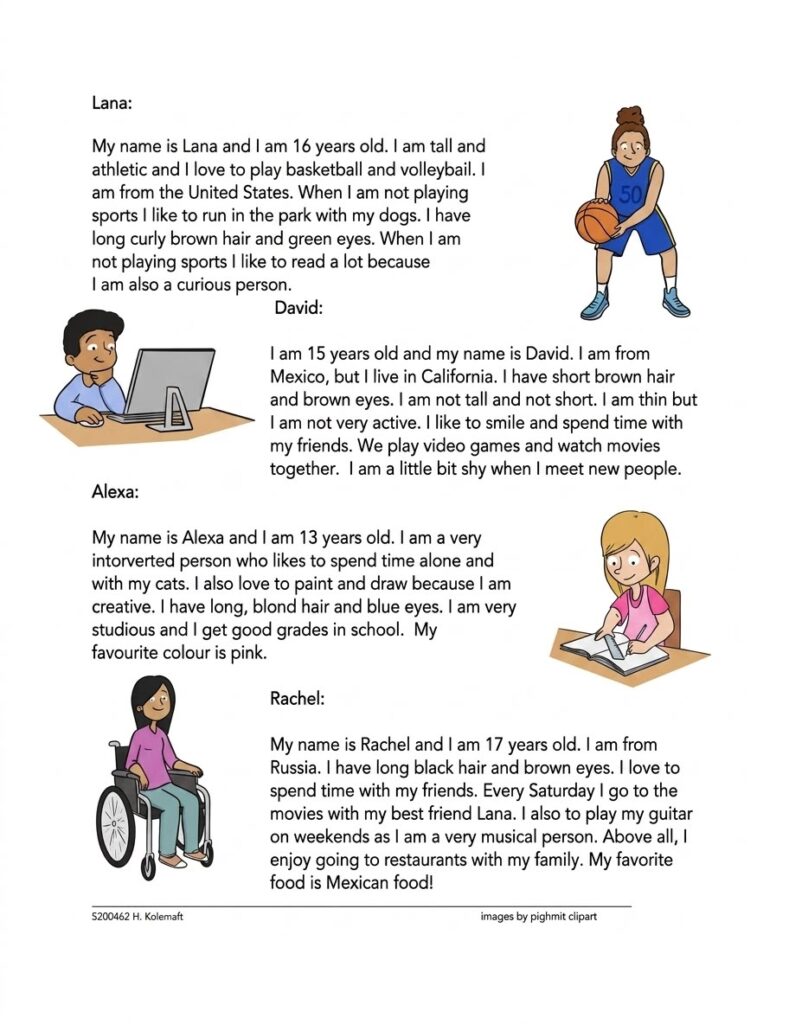
1. Which sport does Lana enjoy playing?
- A) Soccer and tennis
- B) Basketball and volleyball
- C) Swimming and running
- D) Baseball and hockey
2. What color are Lana’s eyes?
- A) Brown
- B) Blue
- C) Green
- D) Black
3. Where is David originally from?
- A) California
- B) The United States
- C) Russia
- D) Mexico
4. How does David describe his personality when meeting new people?
- A) Creative and loud
- B) Very active and athletic
- C) A little bit shy
- D) Confident and outgoing
5. Who likes to spend time alone with their cats?
- A) Lana
- B) Alexa
- C) Rachel
- D) David
6. Why does Alexa love to paint and draw?
- A) Because she is creative
- B) Because she wants to get good grades
- C) Because it is her favorite hobby with friends
- D) Because her favorite color is pink
7. How old is Rachel?
- A) 13 years old
- B) 15 years old
- C) 16 years old
- D) 17 years old
8. What does Rachel do every Saturday?
- A) She plays her guitar on the weekend
- B) She goes to the movies with her best friend Lana
- C) She goes to a restaurant with her family
- D) She runs in the park with her dogs
9. What is Rachel’s favorite type of food?
- A) Russian food
- B) American food
- C) Mexican food
- D) Italian food
10. Which two people explicitly mention that they love to read or study?
- A) Lana and Alexa
- B) David and Rachel
- C) Lana and Rachel
- D) David and Alexa
KEYS
1: Public Transport (Vocabulario y Frases)
Tipo de ejercicio: Selección múltiple (Quiz de 5 preguntas)
- Question 1: B) What time does the next train leave? (Es lo que dice textualmente el letrero transparente de la joven).
- Question 2: C) A ticket to Madrid, please. (Frase ideal para pedir un boleto al destino mencionado).
- Question 3: D) I am lost. (Corresponde exactamente a la opción número 5 de la lista).
- Question 4: C) Train station (Es la traducción correcta de “estación de tren”).
- Question 5: A) I am lost. (Frase que utiliza un pasajero extraviado).
2: Job Offer (Warehouse Assistant)
Tipo de ejercicio: Inferir vocabulario (Ejercicios variados)
- Ejercicio 1 (Emparejamiento):
- A) Organize products ➔ 2) Organizar productos
- B) Control inventory ➔ 3) Controlar el inventario
- C) Prepare delivery boxes ➔ 1) Preparar cajas de entrega
- Ejercicio 2 (Selección Múltiple): B) Puntualidad.
- Ejercicio 3 (Verdadero/Falso): False. (El anuncio dice “Experience not required”, por lo que NO es obligatoria).
- Ejercicio 4 (Completar Espacios):
- Health insurance = Seguro de Salud / Médico.
- Free lunch = Almuerzo gratis.
- Ejercicio 5 (Identificación):
- A) ¿Cómo se dice “Currículum”? ➔ CV (o Curriculum Vitae).
- B) ¿Cómo se dice “Fecha límite”? ➔ Deadline.
3: Voice Levels (Cartel Escolar)
Tipo de ejercicio: True or False (Verdadero o Falso)
- Statement 1: False. (El nivel 0 es “Total Silence”, no se permite hablar ni de forma baja).
- Statement 2: True. (El nivel 2 está etiquetado como “Small group / Normal voice”).
- Statement 3: True. (El nivel 1 corresponde textualmente a “Whisper only”).
- Statement 4: False. (Para presentar se usa el nivel 4; el nivel 5 es para exteriores, “Outside voice”).
- Statement 5: False. (El nivel 3 “Loud Voice” es un volumen menor que el nivel 4 “Presenting”).
4: Brownlow Student Health (Letrero Clínico)
Tipo de ejercicio: Términos Pareados (Matching)
- 1 (Student Health) ➔ C) Salud estudiantil
- 2 (Find us) ➔ D) Encuéntranos
- 3 (Portakabin) ➔ E) Módulo prefabricado / Caseta
- 4 (Peach Street) ➔ B) Dirección / Calle
- 5 (Online registration) ➔ A) Registro en línea
5: University of Liverpool (Estandarte Azul)
Tipo de ejercicio: Selección múltiple (Quiz de 5 preguntas)
- Question 1: C) University of Liverpool (Se aprecia claramente en el escudo superior).
- Question 2: A) The Original Redbrick University (Es el gran eslogan central del cartel).
- Question 3: B) From the distinctive red brick of the Victoria Building. (Lo especifica el texto secundario del medio).
- Question 4: C) 1892 (Año de finalización del edificio Victoria indicado abajo).
- Question 5: B) Make headlines and make history. (Texto pequeño en la base del cartel).
6: Gráfico de Temperatura Individual
Tipo de ejercicio: Preguntas Abiertas (Sin alternativas)
- Question 1 Answer: August (Agosto, con una cima de aproximadamente 26 °C).
- Question 2 Answer: Around 11 °C or 12 °C (Aproximadamente 11 °C o 12 °C).
- Question 3 Answer: February and March (Febrero y Marzo se mantienen estables en la misma línea horizontal).
- Question 4 Answer: It decreases. (Disminuye sustancialmente desde los 26 °C hasta los 13 °C).
- Question 5 Answer: October (En octubre la línea vuelve a cruzar exactamente la marca de los 20 °C tras el verano).
7: Cuatro Gráficos Combinados
Tipo de ejercicio: Selección múltiple (Quiz de 5 preguntas)
- Question 1: D) 76-100 (La barra naranja de mujeres supera por mucho a la verde de hombres).
- Question 2: C) Asia (El sector morado tiene el 30% asignado).
- Question 3: B) August (Coincide con la cima de la curva de temperatura).
- Question 4: B) Farm 3 (Es la barra más baja con solo 48 árboles).
- Question 5: D) 102 (El número rojo sobre el dibujo de la granja 5 indica exactamente 102).
8: DESCRIBING PEOPLE
- 1. B (Basketball and volleyball)
- 2. C (Green)
- 3. D (Mexico)
- 4. C (A little bit shy)
- 5. B (Alexa)
- 6. A (Because she is creative)
- 7. D (17 years old)
- 8. B (She goes to the movies with her best friend Lana)
- 9. C (Mexican food)
- 10. A (Lana and Alexa)