

INTRODUCTION
MÓDULO 1
“Signs and Messages in the City”
Reading Context: Carlos camina hacia su trabajo y luego a la escuela. En su trayecto, ve diversos carteles y recibe un mensaje de su profesor por correo electrónico.
Section I: Vocabulary & Signs (Señalética)
Traduce o encuentra el significado de estas señales comunes de la vía pública:
- NO ENTRY: ____________________
- DANGER: ____________________
- PUSH: ____________________
- PULL: ____________________
- EXIT: ____________________
- WET FLOOR: ____________________
- BUS STOP: ____________________
Section II: True or False (T / F)
Lee el siguiente correo electrónico y responde T (Verdadero) o F (Falso):
“Dear students, tomorrow there is no English class. The school is closed for a meeting. We have Math on Wednesday at 19:00 PM in the library. Please, bring your books. Regards, Mr. Soto.”
- ____ The message is for the teachers.
- ____ There is no English class tomorrow.
- ____ The school is open tomorrow.
- ____ The Math class is on Wednesday.
- ____ The class is at 7:00 PM (19:00).
- ____ The class is in the cafeteria.
- ____ Students need to bring their books.
Section III: Short Answers
Responde brevemente en inglés o español según tu nivel:
- Who sent the email? (¿Quién envió el correo?): ____________________
- Why is the school closed? (¿Por qué está cerrada la escuela?): ____________________
- What is the name of the teacher? (¿Cómo se llama el profesor?): ____________________
- What subject is the class on Wednesday? (¿De qué es la clase el miércoles?): ____________________
- Where is the class going to be? (¿Dónde será la clase?): ____________________
- At what time is the class? (¿A qué hora es la clase?): ____________________
- Does the email mention Carlos’ name? (¿Menciona el email el nombre de Carlos?): ____________________
Signs and Messages in the City
To: All Students
“Dear students, tomorrow there is no English class. The school is closed for a meeting. We have Math on Wednesday at 19:00 PM in the library. Please, bring your books. Regards, Mr. Soto.”
Evaluation Scale: 1.0 to 7.0 | EPJA Level: Middle Cycle 1
MÓDULO 2
Reading Comprehension Activity: “A Busy Day”
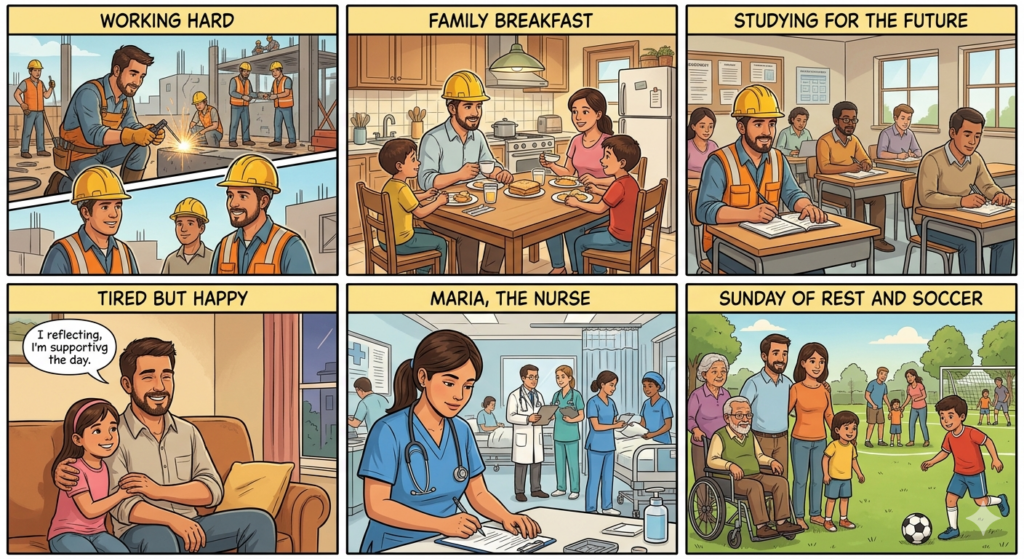
“My name is Carlos. I am 35 years old and I live in Santiago. I am a construction worker and a student in the EPJA program. Every day, I get up at 6:00 AM. I have breakfast with my family and then I go to work. In the afternoon, I go to school to study English and Math. I am tired, but I am happy because I want a better job. My favorite day is Sunday because I rest and play football with my friends.”
Section I: Vocabulary (Translate or Match)
Encuentra el significado de estas palabras clave del texto:
- Construction worker: ____________________
- Every day: ____________________
- Breakfast: ____________________
- Tired: ____________________
- Better job: ____________________
- Watch TV: ____________________
- Nurse: ____________________
Section II: True or False (T / F)
Escribe T si la oración es verdadera o F si es falsa según el texto:
- ____ Carlos is thirty-five years old.
- ____ He lives in Valparaíso.
- ____ He is a doctor.
- ____ He gets up at six o’clock.
- ____ He studies English and Math in the morning.
- ____ He is happy because he wants to progress.
- ____ His wife works at a school.
Section III: Short Answers
Responde brevemente en inglés o español según tu nivel:
What is his wife’s name? ____________________
What city does Carlos live in? ____________________
What does he do at 6:00 AM? ____________________
Who does he have breakfast with? ____________________
When (at what time of day) does he go to school? ____________________
Why is Carlos happy? ____________________
What is his favorite day of the week? ____________________
Answer Key (Claves de Respuestas)
| Ejercicio | Section I: Vocabulary | Section II: True/False | Section III: Short Answers |
|---|---|---|---|
| 1 | Obrero / Trabajador construcción | T | Santiago. |
| 2 | Todos los días | F (Lives in Santiago) | He gets up (Se levanta). |
| 3 | Desayuno | F (Construction worker) | With his family (Con su familia). |
| 4 | Cansado/a | T | In the afternoon (En la tarde). |
| 5 | Mejor trabajo | F (In the afternoon) | Because he wants a better job. |
| 6 | Ver televisión | T | Sunday (Domingo). |
| 7 | Enfermera | F (Works at a hospital) | Maria. |
Reading Comprehension: A Busy Day
Resultado de la Evaluación
KEYS
Módulo 1
| Ejercicio | Section I: Vocabulary & Signs | Section II: True or False | Section III: Short Answers |
|---|---|---|---|
| 1 | Prohibido el paso / No entrar | F (Es para los estudiantes) | Mr. Soto |
| 2 | Peligro | T | For a meeting (Por una reunión) |
| 3 | Empujar | F (Estará cerrada) | Mr. Soto |
| 4 | Tirar / Jalar | T | Math (Matemáticas) |
| 5 | Salida | T (19:00 son las 7 PM) | In the library (En la biblioteca) |
| 6 | Piso mojado | F (Es en la biblioteca) | At 19:00 PM (A las 7 PM) |
| 7 | Parada de autobús | T | No (Dice “Estimados estudiantes”) |
Módulo 2
Answer Key (Claves de Respuestas)
| Ejercicio | Section I: Vocabulary | Section II: True/False | Section III: Short Answers |
|---|---|---|---|
| 1 | Obrero / Trabajador construcción | T | Santiago. |
| 2 | Todos los días | F (Lives in Santiago) | He gets up (Se levanta). |
| 3 | Desayuno | F (Construction worker) | With his family (Con su familia). |
| 4 | Cansado/a | T | In the afternoon (En la tarde). |
| 5 | Mejor trabajo | F (In the afternoon) | Because he wants a better job. |
| 6 | Ver televisión | T | Sunday (Domingo). |
| 7 | Enfermera | F (Works at a hospital) | Maria. |