Unit Overview
1.- Target level: Adult education (3rd and 4th grade high school equivalent)
2.- Core topic: Business costs and break-even analysis
3.- Language focus: English modal verbs for decision-making
Key Concepts
1.- Fixed Costs: Expenses that do not change with production volume.
2.- Variable Costs: Expenses that change based on production output.
3.- Break-Even Point: The sales level where total costs equal total revenue.
Grammar and Usage
1.- Use must for essential business rules.
2.- Use should for wise financial choices.
3.- Use can to find production capacity.
Core Cost Concepts (Conceptos Base de Costos)
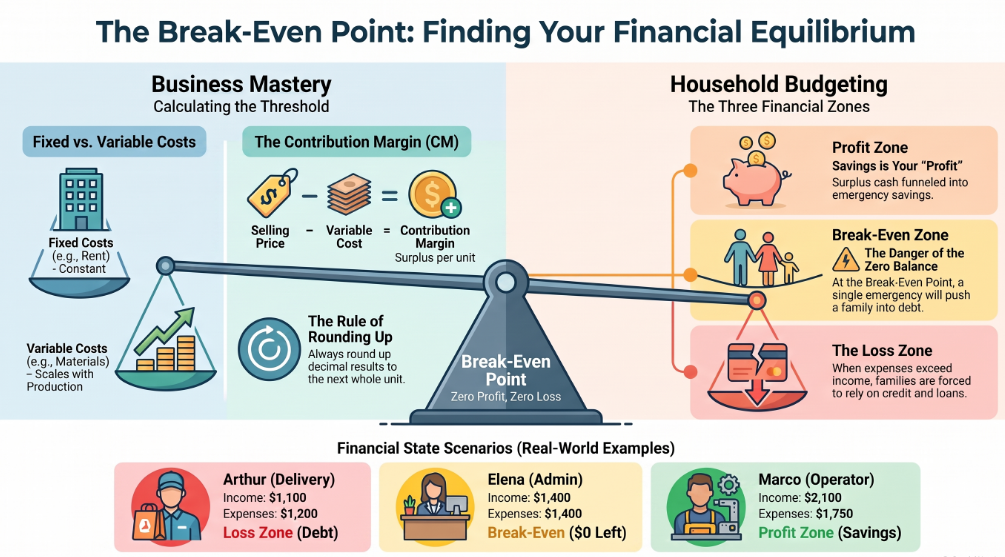
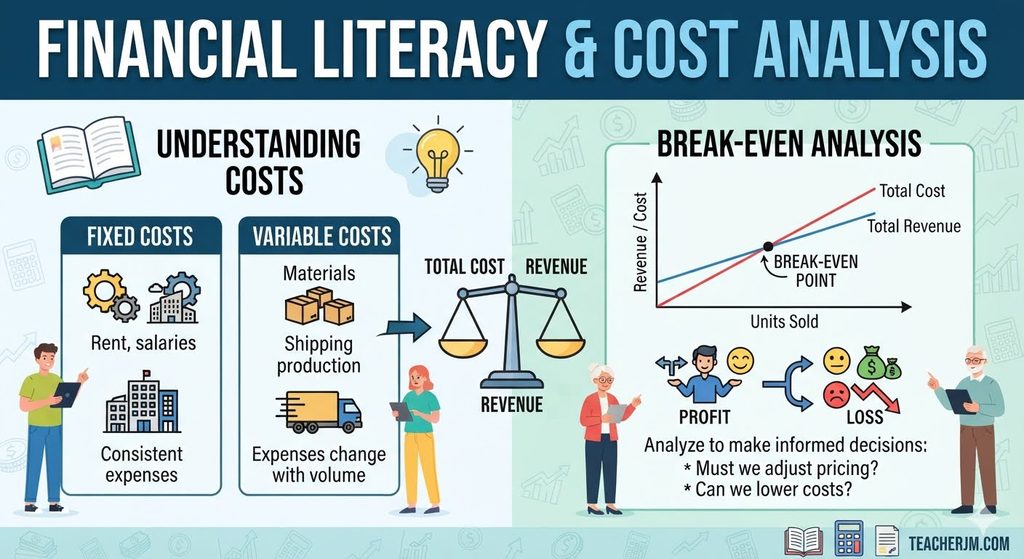
1.- Fixed Costs (FC): Business expenses that do not change, regardless of how much you produce or sell. (Examples: Rent, insurance, and monthly salaries).
2.- Variable Costs (VC): Corporate expenses that change in direct proportion to production volume. (Examples: Raw materials, plastic packaging, and delivery fees).
3.- Total Cost (TC): The sum of fixed costs plus variable costs for a specific level of production.
4.- Overhead Costs: Ongoing business expenses that are not directly linked to creating a specific product but are necessary to keep the business running (e.g., electricity, internet, accounting).
5.- Depreciation: The reduction in the economic value of an asset (like machinery or tools) over time due to wear and tear.
🔹 Revenue and Volume Concepts (Conceptos de Venta y Volumen)
1.- Selling Price: The final amount of money a customer pays to buy one unit of a product or service.
2.- Total Revenue: The total amount of money a business brings in from selling its goods or services.
3.- Units: The individual items or quantified services produced, measured, and sold by a business.
4.- Sales Volume: The total number of units sold during a specific period.
🔹 Profitability and Analysis (Conceptos de Rentabilidad y Análisis)
1.- Contribution Margin: The selling price per unit minus the variable cost per unit. It shows how much money helps cover fixed costs.
2.- Break-Even Point (BEP): The exact moment when total costs and total revenues are equal. The business makes no profit and suffers no loss.
3.- Profit: The financial gain made when the total revenue from a business activity exceeds its total expenses.
4.- Loss: The financial deficit that occurs when a business spends more money than it earns.
5.-Margin of Safety: The difference between actual (or expected) sales and the break-even point. It shows how much sales can drop before a loss begins.
6.- Target Profit: The specific amount of net income that a business owner wants to achieve during a specific period.
Elena wants to open a small food truck in her neighborhood. Before she buys any ingredients, she must plan her cost structure carefully.

First, she identifies her fixed costs. The food truck monthly rent and municipal permits are fixed costs because they do not change, regardless of how many units she sells. She should also consider the depreciation of her kitchen equipment, as tools lose value over time.

Second, Elena analyzes her variable costs. The meat, bread, and plastic packaging are variable costs because they change in direct proportion to her production volume.

Elena sets the selling price of each burger at $6. If her variable cost per burger is $2, her contribution margin is $4. This means every burger sold helps cover her overhead costs like electricity and gas.

To survive, Elena must find her break-even point. This is the exact moment when her total costs and total revenues are equal, meaning she makes no profit and suffers no loss. If she sells more units than the break-even point, she will generate a profit. If she sells fewer units, she will operate at a loss.

Finally, Elena can calculate her target profit. She does not want to just break even; she should aim for a high margin of safety so her business stays safe even during bad sales months.
🔎 Reading Comprehension Questions
- Identify Obligations: Find one example in the text where the modal verb must is used. Why is that action critical for Elena?
- Analyze Costs: Why are ingredients considered variable costs while rent is a fixed cost? Explain based on the text.
- Calculate Conceptually: If Elena’s selling price is $6 and her variable cost is $2, what happens to the remaining $4 contribution margin?
🧮 Math Exercise: Elena’s Food Truck Calculations
Scenario Data:
- Fixed Costs (FC): $1,200 per month (Rent, permits, depreciation)
- Selling Price (SP): $6 per burger
- Variable Cost (VC): $2 per burger
📋 Step-by-Step Task
Follow the steps below to help Elena analyze her business capacity and make responsible decisions.
Step 1: Calculate the Contribution Margin (CM)
Formula: Contribution Margin = Selling Price - Variable Cost
- Task: Subtract the variable cost from the selling price to find how much money from each burger helps cover Elena’s fixed costs.
- Your Calculation: ________________
Step 2: Find the Break-Even Point (BEP) in Units
Formula: Break-Even Point (Units) = Fixed Costs / Contribution Margin
- Task: Divide the total monthly fixed costs by the contribution margin you found in Step 1. This tells you exactly how many burgers Elena must sell to avoid a loss.
- Your Calculation: ________________
Step 3: Calculate the Break-Even Revenue
Formula: Break-Even Revenue = Break-Even Units × Selling Price
- Task: Multiply the number of break-even burgers by the price of each burger. This is the minimum total revenue Elena can generate to make zero profit and zero loss.
- Your Calculation: ________________
Step 4: Analyze a Risk Scenario (Margin of Safety)
- Elena expects to sell 450 burgers next month.
- Task: Calculate her Margin of Safety in units using this formula:
Margin of Safety = Expected Sales - Break-Even Units. - Question: If sales drop by 100 units due to bad weather, should Elena worry about a financial loss? Why?
- Your Answer: ________________
- —————————————
- Teacher’s Answer Key (For Your Reference)
- Step 1: $6 – $2 = $4 contribution margin per burger.
- Step 2: $1,200 / $4 = 300 burgers per month. Elena must sell 300 burgers to break even.
- Step 3: 300 units × $6 = $1,800 in total revenue.
- Step 4: 450 – 300 = 150 burgers margin of safety. If sales drop by 100 units, she is still selling 350 burgers (which is above her BEP of 300). She should not worry about a loss, as she will still make a profit.